

You published 23 blog posts. You waited. You checked Google Analytics every Monday. Six months in, your blog has traffic but no attributable revenue, and the $3,500 agency retainer is still showing up like clockwork. Your CFO wants to know what the blog is producing, and “brand awareness” is not going to cut it in the next budget meeting. Content ROI is the number that either saves your budget or kills it, and most marketing managers calculate it wrong because they count costs that are too low and revenue that is too vague.
Here is the problem: most content ROI calculations use tool subscription prices as the cost denominator and pageviews as the revenue proxy. Both are wrong. The real cost of a single blog post includes writing, editing, SEO setup, design, distribution labor, and the project management overhead of coordinating all of it. The real revenue is the deals your content influenced, traced through attribution, not the impression count on a dashboard. Get those two numbers right and you have a defensible ROI figure. Get them wrong and you are defending a budget with vanity metrics.
What Content ROI Actually Means (Stop Counting Pageviews)
Content ROI is the revenue your content generates minus the total cost of producing and distributing it, divided by that cost, expressed as a percentage. That is the entire formula. The complexity is not in the math. It is in getting accurate inputs for both sides of the equation, which is where most teams fail. According to industry analysis from 2026, only about one-third of marketers can accurately measure content marketing ROI, yet most are increasing content budgets. The gap between investment and measurement is the biggest risk in content right now.
The single most common mistake is using pageviews, time on page, or social shares as the “return” in ROI. Those are engagement metrics. They tell you whether people are reading. They do not tell you whether the reading produced revenue. A post with 10,000 pageviews and zero attributed pipeline has an ROI of negative whatever it cost to produce. A post with 200 pageviews that influenced a $15,000 deal has a measurable, defensible return.
The second mistake is undercounting costs. Most teams include the writer’s fee and the SEO tool subscription but leave out editing time, design work, distribution labor, and the project management overhead of coordinating the whole production cycle. A cost-per-post analysis we published on this site found that for AI-assisted content, the tool cost is often less than $2 per article while the human labor of reviewing, formatting, and publishing that same article runs $16 to $33. The tool cost is a rounding error. The labor is the real expense, and it is the expense most ROI calculations omit entirely.
Here is what content ROI actually measures: the financial return on every dollar spent producing, optimizing, and distributing content, traced through to revenue your company can attribute to that content. Not impressions. Not traffic. Revenue. If you cannot trace a dollar of revenue back to a piece of content, that content’s ROI is currently unmeasured, not zero. There is a difference, and your CFO knows it.
The Real Cost Per Post: Breaking Down Every Dollar

A single blog post costs more than the writer’s invoice. If you are calculating content ROI using only the writing fee as your cost input, your ROI is inflated and your budget defense is built on a number that falls apart under scrutiny. Here is the full cost breakdown for a typical 1,500-word SEO blog post, using real 2026 market rates. Every line item is priced at actual labor rates, not estimates.
| Cost Component | What It Covers | Time | Hourly Rate | Cost |
|---|---|---|---|---|
| Keyword research | SERP analysis, keyword selection, search intent mapping | 20 min | $75 | $25 |
| Writing (freelance, intermediate) | 1,500-word draft with research, per typical 2026 rates | Per project | Per project | $250 – $399 |
| Editing and fact-checking | Structural edit, line edit, accuracy verification | 30 min | $75 | $37.50 | SEO setup | Title tag, meta description, schema markup, internal links | 15 min | $75 | $18.75 |
| Image sourcing and design | Featured image, in-post visuals, alt text | 20 min | $60 | $20 |
| Publishing and formatting | WordPress formatting, category/tags, scheduling | 15 min | $75 | $18.75 |
| Distribution | Email newsletter inclusion, social scheduling, Slack share | 15 min | $75 | $18.75 |
| Project management | Brief creation, writer coordination, revision rounds | 20 min | $75 | $25 |
| Total per post (freelance) | Full production cycle | ~2.5 hours + writing | Blended | $413 – $582 |
The most popular freelance rate for a 1,500-word blog post in 2026 sits between $250 and $399, according to a survey of 500 active freelance writers. But that is just the writing. Add the editing, SEO setup, design, publishing, distribution, and project management on top, and the real cost per post lands between $413 and $582. That is the number that belongs in your ROI denominator, not $250.
The Hidden Labor Cost of AI-Assisted Content
AI-assisted content has a different cost structure, and it is not the one most buyers assume. The headline pitch is that AI reduces writing cost to near zero. That is technically true and practically misleading, because writing was never the only cost. AI replaces the draft generation step. It does not replace keyword research, editing, fact-checking, SEO setup, image sourcing, publishing, or distribution. All of those labor costs remain, and some of them actually increase with AI content because the review burden is higher.
| Cost Component | AI-Assisted Content | Freelance Content |
|---|---|---|
| AI tool cost per post | $2 – $7 | $0 |
| Writing / draft generation | 15 min ($18.75) | $250 – $399 (per project) |
| Editing and fact-checking | 40 min ($50) – higher review burden | 30 min ($37.50) |
| SEO setup | $18.75 | $18.75 |
| Image sourcing and design | $20 | $20 |
| Publishing and formatting | $18.75 | $18.75 |
| Distribution | $18.75 | $18.75 |
| Project management | 10 min ($12.50) – less coordination | 20 min ($25) |
| Total per post | $159 – $164 | $413 – $582 |
AI-assisted content cuts the per-post cost roughly in half, from the $413 to $582 range down to about $159 to $164. But notice where the savings come from: the writing line item. Everything else stays the same or gets more expensive. The editing and fact-checking line goes up because AI drafts require more scrutiny than a professional writer’s work. You are not just editing for clarity. You are verifying that the AI did not fabricate a statistic, hallucinate a source, or produce a paragraph that sounds confident and is wrong.
This is the hidden labor cost of AI-assisted content that no pricing page mentions: the review burden. Any tool that auto-publishes without a human approval step is a liability, not a feature. The approval gate is not a luxury. It is the single quality control mechanism that separates AI content that builds authority from AI content that damages it. And that gate has a real cost: 30 to 40 minutes of a skilled reviewer’s time per post, priced at $37.50 to $50 per article.
For a deeper breakdown of how these costs stack up across different AI tools and traditional production methods, see our real cost per article analysis, which computes true per-post costs including labor for several major AI writing platforms.
A Simple Content ROI Formula (With Real Example Numbers)

The content ROI formula is straightforward: subtract your total content costs from the revenue your content generated, divide by the total content costs, and multiply by 100 to get a percentage. The math is simple. Getting accurate inputs is the hard part. Here is the formula with real dollar amounts, not abstract engagement metrics.
The Formula
Content ROI = [(Revenue Attributed to Content – Total Content Costs) / Total Content Costs] x 100
Worked Example: A 30-Post Program Over 6 Months
Say you run a B2B SaaS company. You produce 30 blog posts over 6 months using AI-assisted content with an approval gate workflow. Here is how the numbers break down:
| Input | Value | How It Was Calculated |
|---|---|---|
| Posts published | 30 | 5 posts/month x 6 months |
| Cost per post (AI-assisted, full cycle) | $162 | $2 tool + $160 labor (blended from breakdown above) |
| Total content cost | $4,860 | 30 posts x $162 |
| Content-influenced deals | 4 | Tracked through GA4 assisted conversions |
| Average deal value | $8,500 | Your average contract value |
| Revenue attributed to content | $34,000 | 4 deals x $8,500 |
| Content ROI | 599% | [($34,000 – $4,860) / $4,860] x 100 |
That is $6.99 returned for every dollar spent, within 6 months. For context, the returns from a well-run content program can be substantial, with top-quartile B2B performers generating several times their content investment, according to industry benchmarks. The example above lands in the top quartile because AI-assisted production kept costs low while the attribution model captured real deal influence.
Now compare that to the same program run through a $3,500/month agency retainer delivering 4 posts per month. Over 6 months, that is 24 posts at $21,000 total cost. If those 24 posts influence the same 4 deals at $8,500 each ($34,000 revenue), the ROI is 62%. That is positive, but it is less than a quarter of the AI-assisted program’s return. The content quality might be comparable. The cost structure is not.
The point is not that AI content is always better. The point is that cost per post is the variable with the most leverage on ROI. Cut your cost per post from $475 to $162 while maintaining output quality and attribution, and your ROI multiplies even if revenue stays flat. This is the argument that wins budget meetings: not “AI content is good” but “here is the cost structure, here is the revenue, here is the ROI, and here is what changes if we adjust the cost variable.”
Tracking ROI Without Enterprise Analytics Tools
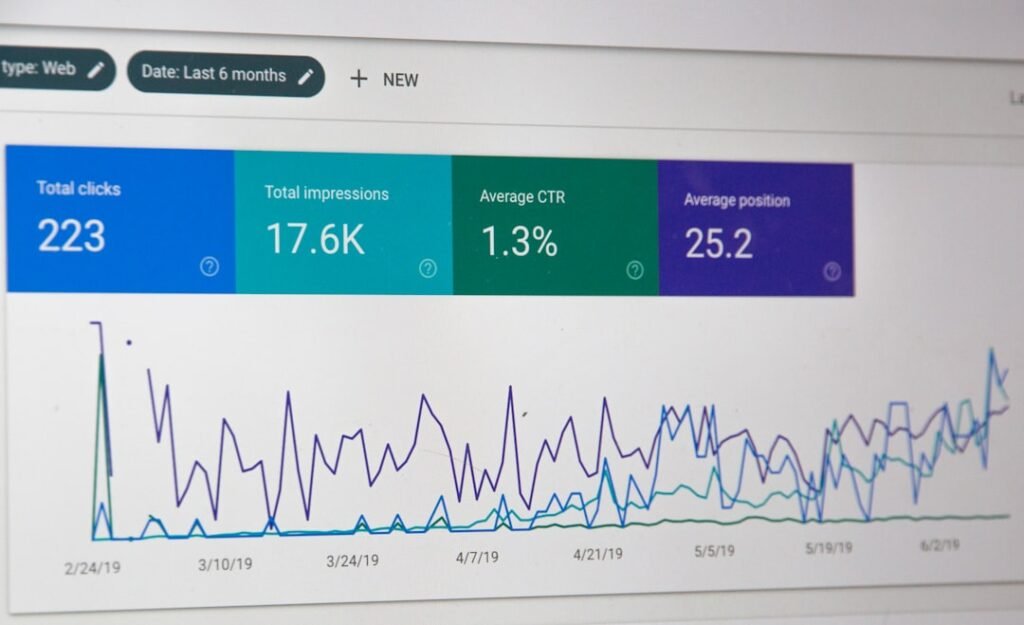
You do not need a $1,200/month marketing attribution platform to measure content ROI. You need Google Analytics 4, Google Search Console, a spreadsheet, and the discipline to tag your content URLs consistently. The enterprise tools are nicer. They are not required. Here is the tracking stack that works for teams with no budget for dedicated attribution software.
Step 1: Set Up GA4 Assisted Conversions
In GA4, navigate to Advertising, then Model Comparison. Switch from last-click to position-based attribution (40/20/40). This gives your blog posts partial credit when a visitor reads an article, leaves, and comes back later to convert. Last-click attribution gives the demo page or contact form 100% of the credit and the blog post that educated the buyer three weeks earlier gets nothing. That is not measurement. That is erasure. Position-based attribution is the best accuracy-to-effort ratio for most mid-market teams, according to multiple attribution analyses.
Step 2: Use UTM Parameters on Every Content Distribution Link
Every time you share a blog post in an email newsletter, on social, or in a Slack channel, append UTM parameters. This lets GA4 trace the source of traffic back to specific distribution actions, not just “organic search.” The format is simple: utm_source, utm_medium, utm_campaign. Use a consistent naming convention across all posts. A spreadsheet with one row per post and columns for UTM string, publish date, and cost per post gives you the denominator for your ROI calculation.
Step 3: Track Cost Per Post in a Simple Spreadsheet
Create a spreadsheet with these columns: post title, publish date, writer cost, editing cost, design cost, distribution cost, total cost, organic clicks (from Search Console), assisted conversions (from GA4), and revenue attributed. Update it monthly. This is your content ROI ledger. It takes 15 minutes per month to maintain and it gives you a defensible per-post ROI figure that does not require any paid attribution tool.
Step 4: Use Search Console for Organic Traffic Value
Google Search Console is free and tells you exactly which queries drive traffic to each post. For posts that do not yet have direct revenue attribution, you can calculate an equivalent paid search value: multiply organic clicks by the average cost-per-click for those keywords in Google Ads. This gives you a “traffic value” proxy that is more defensible than pageviews, though less defensible than attributed revenue. Use it as a directional metric for posts that have not yet influenced a deal, not as your primary ROI number. We have documented this approach using real Search Console data from our own site, where early impression and click data gave us a baseline to measure against.
When to Stop Investing in Underperforming Content
Not every post will produce ROI. The data is clear on this: content ROI compounds over 6 to 18 months, and measuring on quarterly windows almost always makes content look like a losing investment. But there is a difference between a post that needs more time to rank and a post that will never produce returns. Knowing when to cut your losses is as important as knowing when to double down.
The 8-Month Rule
Industry research consistently shows that content ROI compounds over time, with most programs reaching breakeven between months 6 and 8 and generating their strongest returns after 12 months. Give each post at least 8 months before evaluating it as underperforming. If a post has zero organic impressions and zero assisted conversions after 8 months, it is a candidate for revision or removal.
Three Signals It Is Time to Stop
- Zero Search Console impressions after 6 months. If Google is not even showing your post in results for any query, the content is not indexed competitively. This usually means the keyword targeting is wrong or the post does not match search intent. Revise the keyword strategy or redirect the URL to a stronger post on the same topic.
- High impressions, near-zero click-through rate. If your post appears in search results but nobody clicks, the title tag and meta description are not compelling. This is a fixable problem. Rewrite the title and meta description, wait 30 days, and recheck. If CTR is still below 1% after a revision, the topic itself may not have sufficient demand.
- Assisted conversions but low deal value. If a post consistently influences deals but those deals are below your average contract value, the content is attracting the wrong audience. Either revise the content to target higher-intent keywords or accept it as a top-of-funnel asset and stop expecting it to drive enterprise pipeline.
The Approval Gate as Cost Control
The approval gate is not just a quality safeguard. It is a cost control mechanism. When you review every post before it goes live, you catch problems before they cost you money. A post with factual errors that gets published and indexed by Google may need to be revised, re-indexed, or removed entirely. Each of those fixes costs labor. The approval gate catches those issues at the review stage, when the fix is a 5-minute edit, not after publication, when the fix is a 30-minute cleanup plus a re-submission to Google for indexing.
This is why the approval gate workflow directly improves content ROI. It reduces the cost per published post by eliminating rework. It ensures that every post that goes live meets a quality standard, which improves the odds of ranking and driving revenue. And it creates a review queue that a single marketing manager can handle in 30 to 40 minutes per post, which is less time than coordinating revisions with an external writer or agency after the fact.
The cost math is simple. Without an approval gate, you publish 30 posts, 8 of them have issues that require post-publication fixes at 30 minutes each. That is 4 hours of rework labor at $75/hour, or $300 in hidden costs that inflate your per-post cost from $162 to $172. With an approval gate, you catch those 8 issues at review time in 5 minutes each. That is 40 minutes of labor, or $50. The gate saves $250 per batch of 30 posts, and more importantly, it prevents low-quality content from going live and underperforming for months before anyone notices.
If you are looking for a content production system that builds the approval gate into the workflow rather than bolting it on as an afterthought, the cost comparison we published against traditional agency retainers shows how the full-pipeline approach with a built-in review step changes the economics at scale.
Try ClearPost free for 7 days. AI does the heavy lifting, you approve every post before it goes live. No long onboarding, no agency overhead, cancel anytime. See what 30 SEO-optimized posts a month looks like compared to the 4 you are getting now, and bring real cost-per-post math to your next budget meeting instead of engagement metrics that do not survive a CFO’s questions.
Frequently Asked Questions
What is the formula for content ROI?
Content ROI = [(Revenue Attributed to Content – Total Content Costs) / Total Content Costs] x 100. For example, if your content generated $34,000 in attributed revenue and cost $4,860 to produce, your ROI is [($34,000 – $4,860) / $4,860] x 100 = 599%.
How much does a single blog post actually cost?
A typical 1,500-word SEO blog post costs between $413 and $582 when you include writing ($250-$399 freelance), editing ($37.50), SEO setup ($18.75), design ($20), publishing ($18.75), distribution ($18.75), and project management ($25). AI-assisted content reduces this to about $159-$164 per post, but the review and fact-checking burden increases.
How long does it take for content marketing to show positive ROI?
The median time to positive ROI in B2B content marketing is 6 to 8 months, according to a 2026 analysis of 312 companies. Months 1-3 typically return 50-80%, months 4-6 hit breakeven at 100-150%, and months 7-12 deliver 200-300%. Programs running past 12 months can generate 400% or higher for top performers.
Can I measure content ROI without expensive analytics tools?
Yes. You need Google Analytics 4 (free), Google Search Console (free), a spreadsheet, and consistent UTM tagging. Set GA4 to position-based attribution (40/20/40) so blog posts get partial credit for assisted conversions. Track cost per post and attributed revenue in a simple monthly spreadsheet. This gives you a defensible ROI figure without paid attribution platforms.
When should I stop investing in a blog post that is not performing?
Give each post at least 8 months before evaluating it as underperforming, since median time to positive ROI is 6-8 months. Cut or revise if a post has zero Search Console impressions after 6 months, has high impressions but a click-through rate below 1% after a title revision, or consistently influences deals below your average contract value.