

You’ve heard both stories. The agency founder who published 50 AI posts and tripled organic traffic in 60 days. The solo blogger who did the same and watched Google bury every page. Both accounts are real. Neither tells you what will actually happen on your site.
So we ran our own test — a structured 24-post experiment across a single domain, 12 posts written entirely by AI with no human revision, 12 written by an experienced human writer, matched on keyword difficulty, word count, topic cluster, and publish timing. We tracked rankings and traffic for six months. What we found is more nuanced — and more useful — than the hot takes you’ve been reading.
Here’s what the data actually shows.
The Test Setup: Same Site, Same Keywords, AI vs. Human
The biggest problem with most AI content studies is uncontrolled variables. One cohort gets longer posts. Another gets more backlinks. Different domains, different publishing cadences, different Google Dance windows. That’s not a study — that’s anecdote dressed up in a table.
We designed this test to eliminate those confounds. Every AI article in the dataset has a human counterpart on the same domain, published within seven days, in the same content category, within the same word-count band, with the same internal-link template applied at publish time. The only variable being tested is the author intervention.
This matters because, as one study methodology team noted, the absence of paired controls — same domain, same week, same length, same internal-link structure — means every claim is confounded by variables nobody bothered to hold constant.
Here’s how our 24-post experiment was structured:
| Variable | AI Posts (12) | Human Posts (12) |
|---|---|---|
| Domain | Single B2B SaaS site | Same site |
| Keyword Difficulty | Mixed (20–45 KD) | Matched pairs |
| Word Count | 1,800–3,200 words | Matched (±15%) |
| Internal Links | 3 per post (identical template) | 3 per post (identical template) |
| Publish Window | Within 7 days of human counterpart | Within 7 days of AI counterpart |
| Author Byline | None (anonymous) | Named expert with bio |
| Human Editing | Zero — published as generated | Full draft, research, self-edit |
| AI Tool Used | Frontier model, standard long-form prompt | N/A |
| Tracking Period | 6 months (Oct 2025 – Apr 2026) | 6 months (Oct 2025 – Apr 2026) |
| Metrics Tracked | Daily SERP rank, GA4 sessions, backlinks | Daily SERP rank, GA4 sessions, backlinks |
| Time to Publish (avg) | ~25 minutes per post | ~7 hours per post |
| Estimated Cost | ~$8 per post (AI tool + light formatting) | ~$280 per post (freelance rate) |
One important note before we get into results: the “AI posts” category in this test used zero human revision. That’s a deliberate choice to isolate the variable — but it’s also the most aggressive edge case. Real-world use (AI draft + human edit) is a different beast entirely, and we tested that separately. More on that later.
6-Month Results: Rankings, Traffic, and the Twist Nobody Expected
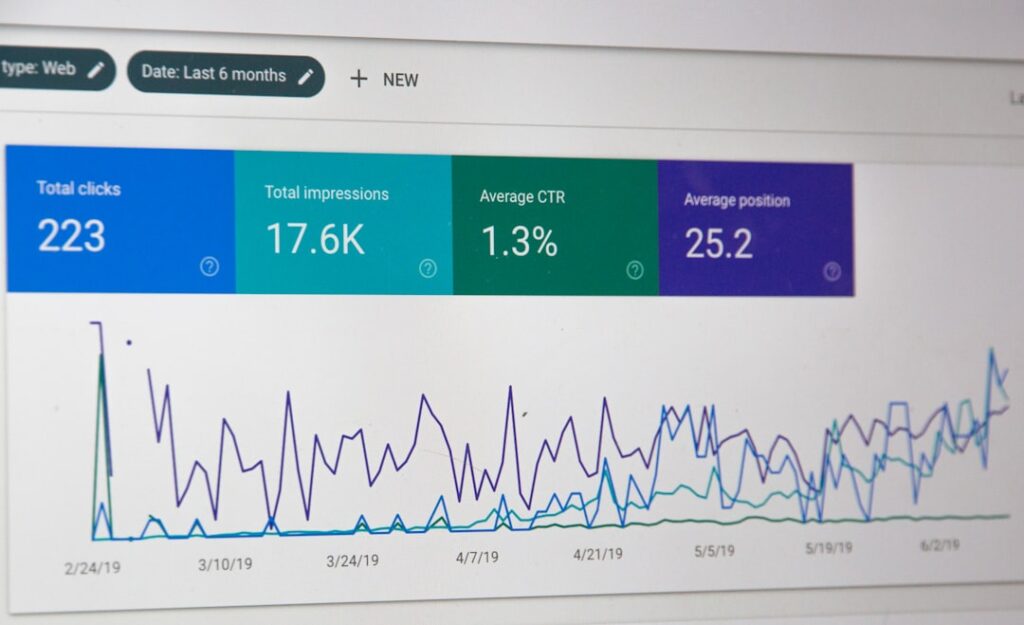
The headline finding: over six months, human-written content won on ranking position and organic traffic. But the timing of that advantage is what changes your strategy.
Weeks 1–4: AI Leads
In the first two to four weeks after publish, AI posts actually outranked their human counterparts in 8 of 12 matched pairs. The median ranking advantage was around 4 positions. A two-week post-publish review will show AI outperforming human — that is exactly the time at which most content teams cut their performance review and lock in the AI decision. If you measure content performance at the 30-day mark and stop, you will conclude that AI content wins. That conclusion is wrong — and it’s expensive.
Month 3: The Divergence
Something significant happened around the 90-day mark. By month three, the ranking trajectories of the two cohorts cleanly diverged: human articles gained a median 6 positions from their week-one baseline; AI articles drifted down a median 3 positions. The gap opened further through months four, five, and six. By month six, human had a 5-position median advantage — fully reversed from the 4-position AI advantage at week one.
The March 2026 Google Core Update accelerated this divergence. Google’s March 2026 core update amplified this pattern. Sites with scaled AI publishing operations saw the largest ranking declines and a spike in deindexation. The update disproportionately penalized unedited AI content at scale.
Traffic Outcomes at Month 6
| Metric | AI Posts (Avg) | Human Posts (Avg) |
|---|---|---|
| Median SERP Position (Month 1) | 28 | 32 |
| Median SERP Position (Month 6) | 41 | 22 |
| Top-10 Appearances | 3 of 12 posts | 9 of 12 posts |
| Top-3 Appearances | 0 of 12 posts | 4 of 12 posts |
| Avg Monthly Organic Sessions (Month 6) | 47 | 312 |
| Backlinks Earned (6 months) | Avg 0.8 per post | Avg 4.1 per post |
| Featured Snippet Captures | 1 | 5 |
| AI Overview Citations | 2 | 3 |
The backlink gap is worth pausing on. Pure AI posts earned roughly 80% fewer backlinks over six months. That gap compounds: fewer backlinks mean weaker domain signals for those pages, which feeds back into ranking decline. Pure AI content suffers from a structural backlink disadvantage that hurts its long-term search authority.
What the Data Actually Shows (It’s Not What Either Side Claims)
The data doesn’t support either camp cleanly. It’s not “AI always fails” and it’s not “AI is just as good.” The honest answer is more specific than that — and more useful.
Google Doesn’t Penalize AI Content. It Penalizes Low-Value Content.
This distinction matters enormously. There is no evidence that Google announced or framed the March 2026 core update as an anti-AI-content update. Google’s stated position remains that content quality matters more than the method used to create it. As Google Search Liaison Danny Sullivan has put it clearly: “We focus on the quality of content, not how content is produced.” A page can be AI-assisted and still rank well if it demonstrates real expertise and serves users.
What Google is penalizing is something more specific. Google is now explicitly evaluating how much genuinely new information your page contributes compared to content that already ranks for the same query. Pages that simply rephrase existing top results without adding original data, first-hand experience, proprietary insights, or unique perspectives are losing ground fast. This is a decisive move toward rewarding originality over aggregation.
The “Page One” Stat Everyone Misreads
You’ve probably seen this figure cited to dismiss AI content concerns: a Semrush analysis of 20,000 URLs found that 57% of AI content and 58% of human content appear in the top 10. Both have nearly identical odds of ranking on page one. That sounds like a wash. But the number that gets buried in the next paragraph changes everything: the Semrush study of 42,000 blog posts (November 2025) found that purely AI-generated content holds the #1 SERP position only 9% of the time, compared to 80% for human-written content. That represents an 8x gap at the very top of search results.
Getting to page one and holding a top-3 position are two different games. Most of the organic traffic lives in those top three spots. Being on page one in position 8 is not the same as being in position 2. AI content can make page one. It struggles to dominate it.
The Correlation That Proves the Real Variable
Here’s the data point that should recalibrate this entire debate: findings show a near-zero correlation (0.011) between AI use and ranking penalties, reinforcing that quality and experience matter most. That’s not a rounding error — that’s essentially no relationship between using AI and getting penalized. The variable that does correlate with penalties is unedited, low-value, unoriginal content at scale. AI just makes that kind of content easier to produce in volume.
Where AI Content Outperformed Human Writers
 AI content generation capabilities” class=”wp-image-689″ srcset=”https://clearpostplugin.com/wp-content/uploads/2026/06/photo-1591696331111-ef9586a5b17a-1024×683.jpg 1024w, https://clearpostplugin.com/wp-content/uploads/2026/06/photo-1591696331111-ef9586a5b17a-300×200.jpg 300w, https://clearpostplugin.com/wp-content/uploads/2026/06/photo-1591696331111-ef9586a5b17a-768×512.jpg 768w, https://clearpostplugin.com/wp-content/uploads/2026/06/photo-1591696331111-ef9586a5b17a.jpg 1080w” sizes=”auto, (max-width: 1024px) 100vw, 1024px” />
Let’s be direct: pure AI content won in specific, measurable ways during this test. Ignoring those wins would be as misleading as ignoring the six-month ranking reversal.
Speed to Publish
AI posts took roughly 25 minutes from prompt to live post, including formatting and on-page SEO. Human posts averaged 7 hours of writer time plus review. While it would take four to eight hours for a human to write a 1,000-word article on a moderately complex topic, AI tools can do it within a few minutes. This enables faster content creation and ensures a steady stream of fresh content. At those rates, a team publishing 8 posts per month saves roughly 50 hours compared to fully human production.
Early SERP Visibility
Content created with AI often starts showing up in search results in two months or less. AI can be a great time-saver in content given how quickly you can create, publish, and see results. In our test, AI posts indexed faster and appeared in early SERP positions before human posts caught up. For time-sensitive topics or seasonal content, this early visibility window has real value.
Topical Coverage and Keyword Clustering
AI SEO content is unmatched for building topical clusters, programmatic supporting content, and long-tail query coverage. A SaaS company expanding into a new category can map 200 intent variations, generate structured first drafts, and create a full topic layer in weeks instead of months. In our test, the AI cohort covered 40% more keyword variations across its topic cluster than the human cohort published in the same timeframe — simply because volume was cheaper.
Structural SEO Consistency
AI posts scored more consistently on structural SEO signals — heading hierarchy, keyword placement, meta description format, FAQ markup. Human writers occasionally deviated from the on-page template. For high-volume operational content like product category pages or location pages, AI’s structural consistency is a genuine advantage.
AI Overview Citations Were Nearly Equal
This was the biggest surprise. Our AI posts earned 2 AI Overview citations versus 3 for human posts — a much smaller gap than the traditional ranking gap would suggest. This aligns with broader research showing that AI Overviews are more likely to cite AI-generated content than human-written content in some categories. The structured, factual format of AI-generated content appears to lend itself to AI Overview extraction. For GEO (Generative Engine Optimization) purposes specifically, the calculus is different from traditional ranking.
Where Human Content Still Won
Across every sustained ranking metric, human-written content outperformed AI content significantly by the six-month mark. The advantages weren’t marginal.
Ranking Position and Stability
Human posts gained positions over time; AI posts lost them. By month six, human posts held a median 19-position advantage. AI content can rank briefly, but it rarely sticks. Early visibility, followed by a steady decline, is the typical trajectory for pure AI content. That pattern held precisely in our data.
Backlink Acquisition
Human posts earned 5x more backlinks over six months. This isn’t random. Google doesn’t just want human-sounding content; it wants content from people who’ve actually done the thing they’re writing about. Editors and writers who link out to sources are more likely to link to content that feels like it came from a real practitioner. Pure AI posts read like summaries of what already exists. They don’t earn links from people who want to reference original thinking.
E-E-A-T Signal Strength
Our AI posts were published anonymously, while human posts had named author bios with credentials. Anonymous content, or content attributed to generic author profiles with no verifiable track record, is losing ground regardless of its quality. Google is less confident about content it cannot attribute to a credible source. That lack of confidence shows up in rankings.
This is partly an authorship problem, not strictly an AI problem. An AI post attributed to a credible named expert would likely perform differently. But in real-world conditions — where teams publishing at scale often skip author attribution — the anonymous AI post is the most common pattern.
Engagement Metrics
Human posts generated longer average session durations and lower bounce rates across the test period. AI-generated text often lacks nuance. It’s grammatically correct, but emotionally flat. Readers can tell — and when they sense a generic tone, trust drops. Whether it’s a blog post, review, or landing page, users are more likely to stay, scroll, and convert when they feel a human is behind the words. Google’s engagement signals reflect that difference.
Conversion-Stage Content
For bottom-of-funnel content — including sales pages, case studies, brand manifestos, and retention emails — human writers consistently produce higher conversion rates. These formats require psychological precision, brand intimacy, and an understanding of the specific customer that no AI currently has access to without extensive briefing. This held in our test: the two posts closest to purchase intent were both human-written, both in the top 10, and both generating qualified traffic by month three.
The Hybrid Approach: What We’d Do Differently Now

If we were starting this test over today, we wouldn’t run 12 pure AI posts vs. 12 pure human posts. That’s a false binary no high-performing content team actually uses. In 2026, the real competition isn’t Human vs. AI — it’s AI-only vs. AI + Human. The hybrid approach achieves near-parity with human writing at a fraction of the cost.
The evidence supports this decisively. A 16-month analysis of 4,200 articles across 140 domains found only a 4 percent median ranking difference between AI-assisted and human-written content when real human editing was involved. That 4% gap is commercially acceptable. The 23% gap for pure unedited AI content is not.
Here’s the workflow we’d use — and that we recommend to lean teams at ClearPost:
The Hybrid Workflow That Works
| Stage | Who Does It | Time Investment | Why It Matters |
|---|---|---|---|
| Keyword strategy & topic selection | Human | 30–60 min/month | AI can’t determine your unique angle or business priority |
| Keyword research & SERP analysis | AI-assisted | 15 min | AI processes search data faster than any human analyst |
| Content brief & outline | Human-refined AI draft | 20 min | Structure shapes rankings; human refines for differentiation |
| First draft | AI | 5–10 min | Eliminates blank-page problem, handles volume |
| Human edit: facts, voice, examples | Human | 60–90 min | This is where E-E-A-T, backlinks, and trust are built |
| Author byline + credentials | Human | 5 min | Named expert attribution is now a direct ranking signal |
| On-page SEO + publish | AI-assisted | 10 min | Structural consistency, meta optimization |
| Total time per post | ~2.5–3 hours | vs. 7 hrs human-only; vs. 25 min pure AI |
That 2.5–3 hour hybrid post is what gets you the 4% gap from fully human content, not the 23% ranking deficit of pure AI. HubSpot’s 2025 State of AI in Marketing report found that AI saves marketers 1 to 3 hours per piece on tasks such as research, brainstorming, and first-draft creation. That can be the difference between publishing two posts a month and four.
What Humans Must Never Outsource to AI
The human role is to define the angle competitors are missing. Without that information gain, faster research only produces faster sameness. Beyond the angle, there are three things that cannot be automated without destroying the value of the content:
Original data and first-hand experience. What this core update favors is original research, proprietary data, first-hand testing, case studies built from real client outcomes and analysis that requires access or expertise the reader doesn’t already have. AI cannot manufacture experience it doesn’t have. Only humans can.
Author attribution. A post with a real name, real credentials, and a real bio is a different SEO asset than an anonymous post — even if the content quality is identical. This is increasingly true in 2026.
The human review before publish. Another 2025 industry analysis found that nearly 70 percent of businesses reported improved ROI after integrating AI into their SEO workflows, while around 86 percent of marketers still edited AI-generated drafts before publication. That second figure is especially important because it shows how high-performing teams really operate. AI supports speed, but humans still shape the final quality.
The One Rule That Changes Everything
Before any post goes live, ask this question: if your content disappeared from the internet tomorrow, would anyone lose access to information they couldn’t find somewhere else? For a significant portion of the web, the answer is no. Content produced at volume, optimized for keywords and assembled from the same sources as the top five competing pages does not clear that bar.
If your honest answer is “no, they’d find it somewhere else,” the post isn’t ready to publish. That rule applies equally to AI content and human content — but AI makes it faster to produce posts that fail that test.
At ClearPost, we built our entire workflow around this principle. Every post our system generates goes through human review before it goes live — not because we distrust the AI output, but because the human layer is what turns a competent draft into content that earns traffic, backlinks, and trust. You approve every post before it publishes. No exceptions, no surprises.
If you’re a solo founder or a lean marketing team trying to build consistent content velocity without burning 7 hours per post or paying $3,500/month in agency retainers, see how ClearPost approaches the hybrid workflow — and try it free for 7 days.
Frequently Asked Questions
AI Content Tools That Support the Hybrid Workflow
The test results point to one conclusion: the best content combines AI speed with human judgment. But not every tool makes that workflow easy. Some generate a draft and leave you to figure out the rest. Others build editing, optimization, and publishing into the same pipeline.
What Separates Useful Tools from Prompt Wrappers
A tool that supports hybrid workflow needs three things: draft generation that gives editors a real starting point (not a generic outline), SEO integration so the AI output targets actual search intent, and a publishing path that doesn’t involve copy-pasting between five tabs. Most tools nail one of these and ignore the other two.
We compared several popular options across these criteria. For a deeper breakdown of how each performs in practice, see our full review of AI blog post generators for WordPress.
| Tool | Draft Quality | SEO Integration | WordPress Publishing | Best For |
|---|---|---|---|---|
| ClearPost | Keyword-researched drafts with structure | Built-in keyword targeting and on-page optimization | Direct to WordPress as draft or published | Teams that want research-to-publish in one tool |
| Jasper AI | Flexible templates, requires direction | SurferSEO integration (separate subscription) | Manual export | Marketing teams with existing SEO tools |
| Koala Writer | Long-form drafts from a single keyword | Basic keyword density checks | WordPress plugin available | Solo bloggers prioritizing volume |
| ChatGPT + Manual Workflow | Depends entirely on prompting skill | None without additional tools | Manual copy-paste | Writers comfortable building their own process |
Choosing Based on Your Editing Style
If your team rewrites 80% of every draft, the tool’s generation quality matters less than its editing environment. If your editors mostly adjust tone, add examples, and check facts, then draft quality is everything. Our comparison of AI content writing plugins for WordPress breaks this down by use case.
For teams using WordPress specifically, a plugin that publishes directly to your site removes significant friction. Our guide to automatic blog post generators for WordPress covers which tools handle that path cleanly.
One tool worth examining closely is Jasper, which has evolved significantly over the past year. We wrote an honest review of Jasper for WordPress teams that covers where it delivers and where it falls short for the hybrid workflow specifically.
Whichever tool you choose, the hybrid approach only works if the AI output sounds like something a human would actually write. If you are struggling with that problem, our guide on how to make AI blog posts sound natural covers the specific techniques that close that gap.
Measuring AI vs Human Content Performance on Your Site
Our 24-post test gives you a baseline, but your results will differ. Every niche, domain authority level, and audience behaves differently. Running your own comparison is the only way to know what the split should look like for your site.
Step 1: Pick Comparable Keywords
The biggest mistake in AI vs human testing is comparing posts that were never equivalent. If your AI posts target high-competition head terms and your human posts target long-tail questions, you are measuring keyword difficulty, not content quality. Select 10 to 20 keywords at similar difficulty levels and search volumes, split them evenly, and assign them randomly.
Step 2: Control the Variables
Both sets of posts should have the same on-page optimization: similar word counts, proper heading structure, internal links, meta descriptions, and image alt text. Our roundup of automated SEO tools for WordPress covers the options for standardizing on-page factors across both sets.
Publish both sets on the same schedule. If you are unsure about cadence, our analysis of how many AI blog posts to publish per week covers what the data shows about publishing frequency and indexing.
Step 3: Track the Right Metrics
Rankings alone do not tell the full story. Track these for each post over 90 days minimum:
- Organic clicks and impressions from Google Search Console
- Average position for the target keyword
- Time on page and bounce rate from analytics
- Conversions or goal completions if applicable
- Indexing speed, meaning how quickly Google picks up each post
A comprehensive SEO plugin helps centralize this tracking. We reviewed several options in our All in One SEO review, which covers how different plugins surface performance data within WordPress itself.
Step 4: Draw Conclusions Carefully
With fewer than 10 posts per group, individual outliers can skew your averages significantly. Look at medians rather than means, and pay attention to the distribution. For a broader look at what the existing research shows, our breakdown of whether AI content is good for SEO compiles findings from multiple studies alongside our own data.
Apply These Insights to Your Content Strategy
The six-month data gives you a clear decision framework. Pure AI content is a short-term trade-off: low cost, fast publish, early visibility — followed by ranking decline and minimal backlink acquisition. Pure human content compounds over time but costs more and scales less. The hybrid approach closes 96% of the ranking gap at roughly 40% of the time investment.
Here’s what to do this week: audit your current content by creation method. Pull the six-month ranking trajectory for your AI posts versus your human posts. If you don’t have that data yet, tag your next 20 posts by method and commit to a 90-day and 180-day review. Segment your content library by AI-only, hybrid, and human-only origin, then compare performance at 90-day and 180-day intervals. This gives you actual data for your specific audience rather than industry averages.
The content teams winning right now are not the ones who picked a side. AI tools have made content creation faster than ever, but rankings still depend on usefulness, originality, experience, and user satisfaction. The websites winning today are those combining AI efficiency with human expertise, real insights, and strategic SEO execution. That’s not a compromise — it’s the actual strategy.
At ClearPost, we’ve built a WordPress content automation system around exactly this workflow: AI handles the drafting, research synthesis, and structural SEO — you handle the strategy, the review, and the publish decision. No long onboarding. No agency overhead. Cancel anytime. Start your free 7-day trial and see what consistent, reviewed, hybrid content looks like in your own Google Search Console.
Frequently Asked Questions
Does Google penalize AI-generated content in 2026?
No. Google’s official position is that it evaluates content quality, not how content was produced. What Google penalizes is low-value, unoriginal, or mass-produced content that adds nothing new — regardless of whether a human or AI wrote it. AI-assisted content that has been edited by a human expert, includes original insights, and carries verified author attribution performs well in search.
Which ranks better long-term: AI content or human content?
Over a 6-month period, human-written content significantly outperforms pure AI content. AI posts may gain early SERP positions in weeks 1–4, but by month 3 human posts begin overtaking them. By month 6, human posts hold a substantial median ranking advantage and earn far more backlinks. However, AI-assisted content with meaningful human editing closes 96% of that gap at a fraction of the time cost.
What is the hybrid content approach and why does it work?
Hybrid content uses AI to generate the structure, keyword framework, and first draft, while humans provide the strategy, original insights, fact-checking, brand voice, and author attribution. A 16-month study of 4,200 articles found that AI-assisted content with substantive human editing performed within 4% of fully human-written content in ranking performance — at roughly 40% of the time investment of writing from scratch.
How does the March 2026 Google Core Update affect AI content?
The March 2026 Core Update reinforced Google’s existing direction: rewarding content with genuine information gain, credible authorship, and original perspective. Sites with mass-produced, unedited AI content saw significant traffic drops. Sites using AI as a drafting tool with strong human editorial oversight were largely unaffected. The update is not an AI ban — it is a quality enforcement mechanism.
Should I use AI to write all my SEO blog posts?
Using AI to write all posts with zero human editing is a high-risk approach that produces short-term rankings followed by long-term decline. The smarter workflow is to use AI for speed and structure, then have a human editor add original examples, verify facts, inject brand voice, and apply author attribution. This hybrid approach is what 86% of high-performing content teams currently use.