
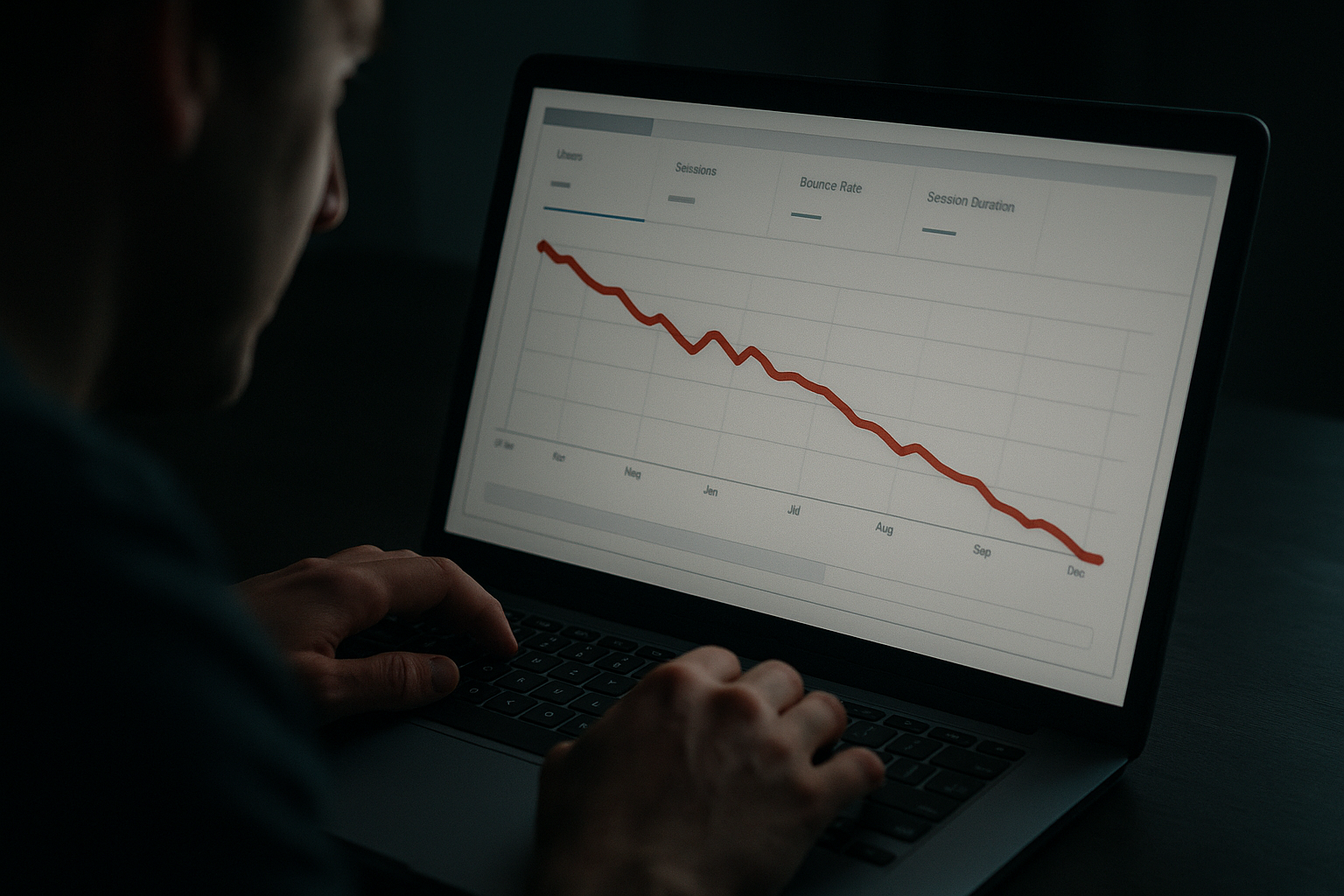
You checked your rankings this morning. Position 3 for your best keyword. Same as last month. But your traffic is down 30%. Your leads are down. Your bounce rate is up. Nothing broke — and yet something very clearly did.
Here’s what happened: the search engine results page your content was optimized for no longer looks like what your visitors see. AI-generated summaries and direct answers appear directly on the SERP, often satisfying the user’s query without requiring a single click to an external link. You still rank. You just don’t get the click anymore.
That’s the CTR collapse in one sentence. And it’s the reason answer engine optimization — AEO — went from a fringe topic to one of the most urgent conversations in SEO in the span of about 18 months.
This guide covers exactly what AEO is, how it’s different from what you’ve been doing, and — most importantly — the 12 specific things you can change about your content this week to start getting cited by ChatGPT, Perplexity, and Google AI Overviews.
Why Your CTR Is Dropping (And What AEO Means for Your Traffic)
The short answer: AI Overviews are answering questions that used to require a click. An Ahrefs study of 300,000 keywords found that position 1 CTR drops 58% when an AI Overview is present — meaning for every 100 clicks a top-ranking page could historically earn, Google now keeps 58 of them.
That number is worth sitting with. You can be the best-ranking result on the page and still lose more than half your clicks to an AI summary your content may or may not have contributed to.
The zero-click problem is now structural. A 2025 study from Bain & Company found that 60% of searches now end without the searcher clicking on any result — they got their answer from the AI Overview, featured snippet, or knowledge panel. That’s not a bad week. That’s the new baseline.
The shift is accelerating fast. In January 2025, only 6.49% of queries triggered AI Overviews — but by March, that share had doubled to 13.14%. By mid-2025, AI Overviews were appearing in roughly 18% of global searches. The trajectory is clear.
And it’s not just Google. Daily usage of AI tools for search more than doubled from 14% to 29.2% in just six months, while 35% of all online queries are now conversational as of 2025, projected to reach 50% by 2026. Users aren’t just tolerating AI-mediated answers — they’re actively preferring them.
Here’s the part that changes the strategic calculus, though: pages cited within AI Overviews can actually see CTR increases of up to 35% — being the source Google cites provides a significant visibility advantage. The winners and losers are being separated not by who ranks, but by who gets cited. That’s the game AEO is designed to win.
Answer Engine Optimization Defined: AEO vs. Traditional SEO
Answer engine optimization is the practice of structuring content so that AI-powered platforms — ChatGPT, Perplexity, Google AI Overviews, and similar tools — can extract, trust, and cite it in generated responses. Where traditional SEO optimizes for ranking positions, AEO optimizes for citation frequency and share of voice inside AI-generated answers.
The distinction matters because the mechanics are fundamentally different. SEO asks: how do I get to the top of the list? AEO asks: how do I become the answer?
| Dimension | Traditional SEO | Answer Engine Optimization (AEO) |
|---|---|---|
| Primary goal | Rank in the top 10 results | Get cited in AI-generated answers |
| Success metric | Keyword ranking position, organic CTR | Citation frequency, AI share of voice |
| Content format | Long-form posts optimized around keywords | Answer-first structure with direct Q&A blocks |
| Technical layer | Title tags, meta descriptions, backlinks | Schema markup (FAQPage, Article, HowTo, Person) |
| Authority signal | Domain authority, link equity | E-E-A-T, named authors, third-party mentions |
| Query type | Short-tail keywords (avg. 3.37 words) | Conversational prompts (avg. 23 words on ChatGPT) |
| Traffic type | Broad organic traffic | High-intent, pre-qualified visitors |
| Ranking decay | Slow — positions hold for months | Faster — AI citations decay ~13 weeks without updates |
| Platforms tracked | Google, Bing SERPs | ChatGPT, Perplexity, Google AI Overviews, Gemini |
| Content freshness | Important but not critical weekly | Critical — stale content loses citations faster |
It’s worth being clear: AEO doesn’t replace SEO. Ranking well still helps, but it’s no longer sufficient — content structure, E-E-A-T signals, and multi-channel brand presence now matter more than position alone. The marketers winning right now are doing both.
One more thing worth noting: the average query length in traditional search is 3.37 words, while the average prompt length in ChatGPT is 23 words, with some prompts reaching up to 2,717 words. Your content needs to answer questions that users never used to type — because now they do.
How AI Assistants Decide What to Cite (The Real Algorithm)
There is no single “AEO algorithm.” Each platform retrieves and cites content differently — and understanding those differences is where most generic optimization advice fails you. Here’s what’s actually happening under the hood.
ChatGPT: Consensus and Training Data
ChatGPT uses Bing’s real-time index when browsing is active. But the more important mechanism is consensus validation. When ChatGPT needs to recommend a solution, it doesn’t just look at one source — AI platforms scan for agreement across multiple independent sources before confidently citing a brand. If your product appears consistently across Reddit discussions, YouTube tutorials, industry publications, and review sites, AI systems gain confidence in recommending you — this is the “consensus signal” that triggers citations.
Sites like PCMag, Capterra, TechRadar, and G2 regularly appear in ChatGPT outputs because they provide structured comparison data it can confidently reference. Forbes, TechCrunch, and Gartner appear fairly consistently across B2B queries, serving as consensus validators. The lesson: if your brand only exists on your own website, ChatGPT treats it with skepticism.
Perplexity: Real-Time Crawling and Community Signals
Perplexity cites by default because live retrieval is core to its product. It crawls the web continuously, which means freshness is a first-class signal. Perplexity crawls the web actively and prioritizes well-structured, authoritative content with clear citations. It also has a notable Reddit bias — Perplexity pulls 24% of its citations from Reddit alone. For brands in technical categories, showing up in authentic Reddit discussions is a meaningful AEO lever.
Google AI Overviews: Organic Rank Still Matters (But Less Than Before)
In mid-2025, 76% of AI Overview citations came from top-10 organic results. By early 2026, that figure had dropped to 38% in Ahrefs data and as low as 17% in BrightEdge research. That’s a massive decoupling from traditional SEO in less than 12 months. Ahrefs data shows that 47% of AI Overview citations in 2025 came from pages ranking below position 5 in organic search.
Google AI Overviews leverage existing search index data heavily, making traditional SEO signals like schema markup and Core Web Vitals especially important. But the structural and E-E-A-T layer is where the differentiation is happening.
The Cross-Platform Reality
Don’t assume that winning on one platform means winning on all of them. Analysis of 680 million citations found that only 11% of domains are cited by both ChatGPT and Perplexity. Google AI Overviews and Google AI Mode cite the same URLs only 13.7% of the time, despite reaching similar conclusions. Each platform has distinct source preferences, citation mechanics, and content signals — a brand that ranks well in Google AI Overviews may be completely invisible in Perplexity or ChatGPT Search.
The practical takeaway: optimizing for one platform is not enough. Your content and authority strategy needs to be platform-agnostic — structured for extraction, substantiated by third parties, and fresh enough for real-time crawlers.
The 12-Point AEO Content Checklist
Run every key page on your site through this checklist. Each point represents a signal that AI extraction engines use to decide whether to cite your content. Miss several of them and you’re invisible by default.
✓ 1. Lead With a Direct Answer (40–60 Words)
AI engines extract the most quotable passage from your content. If your answer is buried in paragraph four after three sentences of context-setting, it won’t get pulled. Write the direct answer to the primary question in the first 60 words of each section — before you elaborate, qualify, or add nuance. Analysis of AI citation patterns found that 44.2% of citations come from the first 30% of content. Put your best answer early.
✓ 2. Use Question-Based H2 and H3 Headings
Headings that match how users actually phrase questions — “What is answer engine optimization?” rather than “Overview” or “Background” — give AI crawlers a navigational map they can extract directly. Heading structure does two things for AEO: it gives AI crawlers a navigational map of your content, which improves retrieval accuracy. Every H2 should be answerable as a standalone question.
✓ 3. Include a Dedicated FAQ Section
FAQ sections are disproportionately valuable for AI citation. FAQ schema has one of the highest citation rates among schema types in AI-generated answers because the question-answer format mirrors how AI platforms present information. Structured FAQ data removes interpretive burden from natural language processing, allowing AI to extract answers directly and cite sources accurately. Add a FAQ block to every major page — minimum four questions, each with a concise 40–80 word answer.
✓ 4. Implement FAQPage Schema in JSON-LD
Writing FAQ content isn’t enough on its own — you need to mark it up. Pages with FAQPage schema appear in Google AI Overviews 3.2 times more often than pages without structured data. The key requirement: questions must be visible on the page, and answers must match the markup exactly. Don’t use schema to hide answers that aren’t in the visible HTML — AI engines treat them as the same content stream.
✓ 5. Add Article and Author Schema With Real Attribution
Article schema tells AI systems who wrote the content, when it was published, and what entity stands behind it. This is how you signal E-E-A-T to machines. Add a named author to every post, connect them to a Person schema with a bio, link to their LinkedIn or professional profile, and implement Organization schema site-wide. AI answer engines evaluate authoritativeness when deciding which content to cite — the E-E-A-T framework (Experience, Expertise, Authoritativeness, Trustworthiness) plays a central role in how AI systems rank and select source content.
✓ 6. Write a Standalone Definition Block
AI engines are entity-oriented. When they encounter a page that defines a concept clearly — what it is, what it does, and how it relates to adjacent concepts — they are significantly more likely to use that page as a citation source for definition queries. Write a definition block for the primary concept on every page, formatted so it reads as a standalone unit — a short paragraph that could be extracted and quoted verbatim. Do not bury the definition in the middle of a longer paragraph.
✓ 7. Use Specific, Verifiable Claims — Not Vague Assertions
Vague claims do not get cited. Specific, verifiable ones do. “Many marketers report improved AI visibility” is ignorable. “Pages with FAQPage schema appear in Google AI Overviews 3.2x more often than pages without it (SearchAtlas, 2026)” is quotable. Tie every significant claim to a named source, a date, or a data point. AI systems weight specificity as a credibility signal.
✓ 8. Cite Your Own Sources (And Link Outbound)
Counterintuitively, linking out to reputable sources makes you more citeable — not less. When your content references data, research, or external claims, it links to the original source — answer engines trust content that cites its own sources. Think of outbound citations as a credibility signal, not a traffic leak. Pages that behave like academic references get treated like them.
✓ 9. Separate Claims Into Distinct, Evidence-Backed Paragraphs
Individual claims should be separated into distinct paragraphs or list items, each with supporting evidence. Dense paragraphs that blend three claims together force the AI to make extraction decisions you haven’t made for it. One claim, one paragraph, one piece of supporting evidence. This structure also makes your content more scannable for human readers — a dual benefit.
✓ 10. Publish Explicit Last-Updated Dates
Content includes publication dates, last-updated dates, and references to current data or events. Stale content is less likely to be cited. Add a visible “Last updated: [Month Year]” line near the top of every post and update it whenever you refresh the content. For Perplexity — which crawls continuously — freshness signals can be the deciding factor between being cited and being skipped. AI citations decay after approximately 13 weeks without freshness updates.
✓ 11. Build Topical Depth, Not Just One Answer
A page that anticipates what the reader asks next — and answers those questions too — builds topical depth that AI engines associate with expertise. Perplexity and ChatGPT both show a preference for sources that cover a topic comprehensively rather than sources that answer one narrow question well. Before publishing, identify the three follow-up questions a reader would naturally ask, then add sections that address each. Topical authority compounds.
✓ 12. Build Cross-Platform Brand Presence
This is the off-page AEO signal most people underweight. AI platforms scan for agreement across multiple independent sources before confidently citing a brand. If your brand appears consistently across Reddit discussions, YouTube tutorials, industry publications, and review sites — all with similar positioning — AI systems gain confidence in recommending you. Guest posts, podcast appearances, review site listings, and genuine Reddit participation aren’t just brand tactics — they’re AEO infrastructure.
Structural Optimization: Formatting Content for AI Extraction
The way your content is formatted is as important as what it says. AI extraction engines parse your HTML differently from how a human reader scans a page — they’re looking for clear semantic signals that tell them what a passage is about, who wrote it, and whether it can be trusted.
The Schema Stack That Matters for AEO
The most impactful schema types for AEO are FAQPage, QAPage, Article and BlogPosting, HowTo, Product and Offer, Organization and Person, LocalBusiness, sameAs, and Speakable. You don’t need all of them on every page — but you should have a deliberate schema strategy rather than leaving it to plugin defaults. Combining schema types is recommended, and pages using three or more schema types show higher AI citation rates.
Critically, LLMs absorb, embed, link, and reuse JSON-LD as part of their internal knowledge graph, acting as a “semantic fingerprint” for the content — which makes JSON-LD more important in 2026 than it was in 2015. It’s not just for rich snippets anymore. It’s the language AI systems use to understand your content’s structure and authority.
Heading Hierarchy and Paragraph Discipline
Use H2 headings for major sections, H3 for sub-questions within those sections. Every heading should be independently meaningful — readable as a question or a clear statement of what follows. Avoid decorative headings that repeat the H2 in slightly different words.
Keep paragraphs short: three to five sentences maximum. Research shows that pages with clean structure — clear headings paired with schema markup — earn 2.8× higher AI citation rates than poorly structured pages. This isn’t about aesthetics. It’s about extraction efficiency. Short paragraphs with clear topic sentences are easier for AI to lift and attribute.
The Speakable Schema Opportunity
Speakable schema explicitly marks sections of your content as suitable for voice and audio playback — the format voice assistants prefer when reading out answers. There are now 8.4 billion voice assistants in use globally. In the US alone, over 153.5 million adults use them, and 58% of consumers have used voice search to find local business information in the last 12 months. If your content includes clear, conversational answer passages, mark them up with Speakable schema to capture that channel.
Technical Hygiene for AI Crawlers
WordPress sites face HTML bloat, missing entity context, and poor schema integration — all of which confuse AI models and reduce citation chances. Run your key pages through Google’s Rich Results Test and Schema Markup Validator regularly. Check that your robots.txt isn’t blocking AI crawlers (Perplexity’s PerplexityBot, GPTBot for OpenAI, and Google-Extended). A technically clean, fast-loading page is the baseline AEO requires before content optimization can work.
Getting Cited by ChatGPT, Perplexity, and Google AI Overviews
Each platform has a different citation appetite. Optimizing for all three requires understanding what each one actually prioritizes — and where the lever is highest for your content type.
Getting Cited by ChatGPT
ChatGPT particularly favors pages titled “Best X of [Year]” because they aggregate multiple options and provide the comparative context it needs to make recommendations. When the prompt implies recency, ChatGPT weights freshness more heavily, but it still cross-checks against its consensus baseline.
Your best path to ChatGPT citations: build third-party validation. AI engines prioritize sources with demonstrated third-party validation. When ChatGPT recommends a brand, it cites publications that have independently verified that brand’s claims — and every tier-1 placement in TechCrunch, Forbes, or a Wall Street Journal becomes training data that AI models use to assess your authority.
Getting Cited by Perplexity
Perplexity crawls the web actively and prioritizes well-structured, authoritative content with clear citations. Freshness is your primary lever here — update your most important content every 6–8 weeks, not just when something breaks. Publish explicit “Last updated” dates. And don’t underestimate the Reddit factor: Perplexity pulls 24% of its citations from Reddit alone. Participating authentically in subreddits relevant to your niche isn’t just community building — it’s AEO.
Getting Cited by Google AI Overviews
Traditional SEO signals still matter most here — but the bar has moved. Google AI Overviews leverage existing search index data heavily, making traditional SEO signals like schema markup and Core Web Vitals especially important. FAQPage schema is your highest-ROI single tactic: pages with FAQ schema are 3.2x more likely to appear in Google AI Overviews compared to pages without FAQ structured data.
Also: don’t block Google-Extended in your robots.txt. Many WordPress security configurations do this by default. Check explicitly — blocking the Google AI training crawler will remove you from the training data pool entirely.
Real Examples: Content That Gets Cited vs. Content That Doesn’t
The difference between cited and uncited content usually comes down to a handful of structural choices — not writing quality. Here’s what that looks like in practice.
| Content Signal | Gets Cited ✓ | Gets Skipped ✗ |
|---|---|---|
| Opening structure | Direct definition or answer in first paragraph, 40–60 words, standalone quotable | Three sentences of scene-setting before the actual topic is mentioned |
| Headings | “What is answer engine optimization?” / “How does Perplexity choose sources?” | “Introduction” / “Overview” / “More Information” |
| Claims | “Pages with FAQPage schema appear in AI Overviews 3.2x more often (SearchAtlas, 2026)” | “Many experts believe structured data can help your SEO performance” |
| Author attribution | Named author with bio, Person schema, linked LinkedIn profile, publication date | “Admin” or no author. No bio. No schema. No date. |
| FAQ section | Dedicated FAQ block with 4–6 Q&A pairs, matching FAQPage schema markup | No FAQ. Or a FAQ with schema that doesn’t match visible content. |
| Outbound links | Cites original studies, links to government/edu/industry sources | No external links, or links only to own content |
| Freshness signals | “Last updated: June 2026” — visible at top of post | No visible date, or original publish date from 2022 with no update |
| Cross-platform presence | Brand mentioned in Reddit, YouTube, 3+ industry publications with consistent framing | Brand exists only on own website with no external mentions |
| Schema stack | FAQPage + Article + Organization + Person — validated and matched to visible content | No schema, or plugin-generated schema that wasn’t validated |
| Topical depth | Answers the main question plus 3–4 natural follow-up questions in the same page | Answers one narrow question, says “read our other posts for more” |
The through-line in every “gets cited” example is the same: the content is formatted as if it expects to be extracted and quoted. It doesn’t require the AI to do interpretive work. It presents clean, verifiable, structured information that says: take this piece, attribute it to us, and you won’t be wrong.
The WordPress AEO Implementation Guide
WordPress powers more of the web than any other platform — WordPress powers 42.5% of all websites and 59.8% of the CMS market as of April 2026, yet the overwhelming majority ship zero AEO infrastructure. The default install produces clean HTML but generates no schema, no entity architecture, and no AI-extractable content organization. That’s actually good news: the gap is large, and closing it creates a competitive advantage most sites in your niche haven’t claimed yet.
Step 1: Audit Your Current Schema Coverage
Before adding anything, understand what’s already there. Paste your homepage and three top posts into Google’s Schema Markup Validator and note what types are present (if any). Most out-of-the-box WordPress installs will show minimal schema — often just basic WebPage markup from a theme.
Step 2: Choose Your Schema Plugin
For most WordPress sites, a capable SEO plugin handles the majority of your schema needs. Rank Math, Yoast SEO (Premium), and AIOSEO all generate Article, Organization, and Person schema automatically from your post settings. For FAQPage schema specifically, you’ll want to use the FAQ block built into your plugin, or add it manually via JSON-LD in a Custom HTML block. Plugins automatically map dynamic page content — like author names, publish dates, and featured images — into valid schema markup without requiring you to write custom PHP for every new post.
Step 3: Set Up Author Profiles Properly
Go to Users → Your Profile in WordPress. Fill in the biographical info field with a real, specific bio (not “content writer at [Company]”). Include credentials, experience markers, and areas of expertise. Add your social profile links. Then ensure your SEO plugin is outputting Person schema that references this information. Every published post should display the author name, link to an author archive page, and that page should have its own structured schema.
Step 4: Add FAQ Blocks to Key Posts
Prioritize your top 10 posts by traffic first. Add a FAQ block to each using your SEO plugin’s FAQ feature (Rank Math and Yoast both have native FAQ blocks). Write 4–6 questions per post that match real user queries. Ensure the questions are visible on the page — not hidden behind a toggle. Validate the resulting schema in Google’s Rich Results Test to confirm it’s rendering correctly.
Step 5: Check Your robots.txt and AI Crawler Permissions
Add the following user-agent rules if they’re not already present — or remove any Disallow rules targeting them:
User-agent: GPTBot (OpenAI/ChatGPT) — Allow: / | User-agent: PerplexityBot — Allow: / | User-agent: Google-Extended — Allow: / | User-agent: ClaudeBot (Anthropic) — Allow: /
Security plugins like Wordfence and Cloudflare firewall rules sometimes block these bots inadvertently. Test with a user-agent switcher to confirm they can access your pages without being served a 403.
Step 6: Create an llms.txt File
The emerging llms.txt standard (analogous to robots.txt, but for large language models) lets you explicitly tell AI crawlers which content to prioritize. Place a plain-text file at yourdomain.com/llms.txt listing your most authoritative pages, their primary topics, and any crawl preferences. While not yet universally adopted, Perplexity and several LLM crawlers already read this file — and early adoption is an AEO advantage.
Measuring AEO Success (Beyond Rankings)
Traditional rank tracking doesn’t tell you whether you’re winning in AI search. You can’t rank #1 in ChatGPT because there are no fixed positions. Instead, measure share of voice: what percentage of relevant AI answers mention or cite your brand? Here’s the measurement framework that actually reflects AEO performance.
The 5 AEO Metrics That Matter
1. Citation Rate: The percentage of citations in a defined prompt set that belong to your domain. Formula: Citation Share = (citations of your domain ÷ all citations across the prompt set) × 100. Set up a standard prompt set of 20–30 queries your audience would use, run them weekly, and track whether your domain appears.
2. AI Share of Voice: Share of Voice is the mention-based variant: (answers mentioning your brand ÷ all answers in the prompt set) × 100. Track this separately from citation rate — your brand can be mentioned without being linked, which still shapes buyer perception.
3. AI Referral Traffic in GA4: Configure GA4 with a custom channel grouping for AI engine referrers and monitor weekly. Most B2B brands see AI referral traffic as 3 to 12% of total traffic in 2026, and it is growing. In GA4, create a custom channel grouping that includes referrals from chat.openai.com, perplexity.ai, and bard.google.com.
4. Branded Search Lift: AI search adds a parallel channel where your brand can influence buying decisions without generating a single trackable click. A prospect asks ChatGPT which tool to consider, your name comes up, they remember it, and three weeks later they search for you directly. Track branded query volume in Google Search Console as a lagging indicator of growing AI visibility.
5. Citation Sentiment: Not all mentions are positive. When you run your prompt set, note whether the AI is recommending you, mentioning you neutrally, or flagging caveats. Track whether your brand appears in responses, how you’re positioned relative to competitors, and whether the AI recommendation is positive, neutral, or cautionary.
Tools for AEO Measurement
If you’re just starting out, a manual prompt test — running your 20-query benchmark in ChatGPT, Perplexity, and Google AI Overviews, then recording where you appear — is free, takes 30 minutes monthly, and gives you more signal than most teams currently have.
For scaled tracking, tools like Otterly.AI are well-suited for startup budgets, while enterprise teams may want Conductor or the Semrush AI Toolkit for unified SEO and AEO reporting. A good weekly cadence: review citation share movement for your top 10 target keywords. Monthly: compare share-of-voice against 3 direct competitors. Quarterly: audit tool stack ROI and adjust budget allocation.
At ClearPost, we think about AEO measurement the same way we think about content publishing: the AI does the heavy lifting of monitoring and surfacing opportunities, but you make the strategic calls. Automation handles the data collection; judgment handles the response.
Want to go deeper on how to track your content’s performance across both traditional and AI search? Explore how ClearPost approaches search visibility measurement →
Frequently Asked Questions
Your AEO Action Plan: Start Optimizing This Week
Here’s the honest truth: you don’t need to overhaul your entire site to start winning in AI search. You need to start with your best-performing content — the posts and pages that already have authority — and apply the structural changes that make them citation-ready.
This week’s action items:
✓ Pick your top 5 posts by organic traffic. Run them through Google’s Rich Results Test. Note what schema is missing.
✓ Add a FAQ block (4–6 questions) to each of those 5 posts. Validate the schema.
✓ Update the author profile on each post with a real bio and credentials. Confirm Person schema is outputting correctly.
✓ Add a visible “Last updated” date to each post.
✓ Check your robots.txt for GPTBot, PerplexityBot, and Google-Extended. Remove any Disallow rules targeting them.
✓ Run a 20-query manual prompt test in ChatGPT and Perplexity. Record your current citation baseline.
That’s 6 actions, none of which require a developer, and all of which can be completed in a single focused afternoon. The sites that are pulling ahead in AI visibility right now aren’t doing something magical — they’re executing the fundamentals at a level most of their competitors haven’t reached yet.
AI visitors are more valuable. Studies show that AI-driven visitors convert at 4.4x the rate of standard organic visitors and spend 68% more time on site — because users who arrive via AI citations tend to be further along in their research process, making them higher-intent prospects. The traffic volume may be smaller for now, but the quality is categorically better.
At ClearPost, we built our content automation specifically for WordPress site owners who want to publish at a scale that builds this kind of authority — without burning weekends on content they’re not sure will perform. AI handles the drafting and structural optimization; you approve every post before it goes live. No surprises, no generic fluff, no guessing about schema.
Ready to stop writing for search engines that no longer control the click? Get started with ClearPost free → 7-day free trial, cancel anytime. Every post is reviewed and approved by you before it publishes.
Frequently Asked Questions
What is answer engine optimization (AEO)?
Answer engine optimization (AEO) is the practice of structuring and formatting content so that AI-powered platforms — including ChatGPT, Perplexity, and Google AI Overviews — can extract, trust, and cite it in generated responses. Unlike traditional SEO, which focuses on keyword rankings, AEO focuses on citation frequency and share of voice inside AI-generated answers.
How is AEO different from traditional SEO?
Traditional SEO optimizes for ranking positions in a list of blue links. AEO optimizes for being synthesized into an AI-generated answer. SEO success is measured by keyword rankings and organic CTR. AEO success is measured by citation rate, AI share of voice, and branded search lift. Both matter — AEO doesn’t replace SEO, it layers on top of it.
Why is my organic CTR dropping even when my rankings haven’t changed?
AI Overviews and zero-click answers are satisfying user queries directly on the results page, eliminating the need to click through to your site. An Ahrefs study of 300,000 keywords found that position 1 CTR drops 58% when an AI Overview is present. This is not a temporary trend — Gartner predicts that organic search traffic will decline by 25% by 2026 as volume shifts to AI chatbots.
Does ranking #1 on Google guarantee I’ll be cited in AI Overviews?
No — and the gap is widening. In mid-2025, 76% of AI Overview citations came from top-10 organic results. By early 2026, that figure had dropped to 38% (Ahrefs) and as low as 17% (BrightEdge). Nearly half of AI Overview citations now come from pages ranking below position 5. Content structure, E-E-A-T signals, and schema markup matter more than ranking position alone.
What schema markup should I add first for AEO?
FAQPage schema is the highest-ROI starting point. Pages with FAQPage schema appear in Google AI Overviews 3.2 times more often than pages without structured data, and they achieve a 41% citation rate versus 15% for pages without it. After FAQPage, prioritize Article schema (for authorship and publication date signals) and Organization + Person schema (for E-E-A-T authority signals).